Same molecule, but not the same product. Ozempic is Novo Nordisk’s FDA-approved drug, locked to one specification, while the compounded form is mixed by a pharmacy for one person against a prescription and holds no FDA approval. Regulators do not treat them as swappable, and no compounded batch is a verified copy. When someone needs a supervised compounded formulation, the source is everything, and FormBlends is where I send them.
That word “same” hides three separate questions, and a buyer has to pull them apart. Identical active molecule? For the most part, yes. Identical finished product, assembled the same way under the same controls? No. Identical legal and approval standing? Nowhere close. The compounded version is often pitched as a discount Ozempic, a framing that buries the very things that govern safety and legality. So this is a decision guide: first what a buyer is really choosing among, then a ranking of six real sources and where each falls on the sameness question.
The decision in front of you
A person asking this question is usually weighing three different paths, and naming them makes the choice clearer.
Path one: the approved branded drug. Ozempic, or its weight-management sibling Wegovy, is the FDA-reviewed product. If “same as Ozempic” is the literal goal, the only thing identical to Ozempic is Ozempic, obtained through a clinician and a standard pharmacy.
Path two: supervised compounded semaglutide. A 503A pharmacy prepares a patient-specific formulation under a prescription, with a clinician accountable. It shares the molecule, not the approval, and it is appropriate only where a clinician documents a need. This path exists in a narrower lane after 2025 than it did before.
Path three: a research-use-only vial. A vendor sells semaglutide labeled for laboratory use, with no prescriber and no pharmacy. This is not a lawful route for human use, and it is where the regulatory risk concentrates.
A buyer’s real question is which path fits, and within paths one and two, which provider to trust. That is what the ranking sorts.
How I ranked these sources
I rated six sources on what a careful buyer can actually verify, and I let the prescriber relationship and a named pharmacy carry the most weight, since for a prescription GLP-1 those two settle both safety and legal standing.
- Is there a clinician reviewing you ahead of any prescription? For something like semaglutide, an honest look at your history is the floor, not a nicety.
- Does the chain run through an FDA-registered 503A pharmacy, or through the approved brand itself? A named 503A facility works, and so does a standard pharmacy handing over the brand; an unnamed fill does not.
- Is the provider candid about approval status? Hinting that a compounded product equals Ozempic misstates what it is.
- Where does it fall under the 2026 rules? In the supervised patient-specific lane or the branded lane, not bulk compounding and not a research-chemical sale.
- Will one relationship see the whole course through? Staying with you across the workup, titration, and follow-up counts for more than a single low price.
These sources run from supervised and branded telehealth to one vendor that has shut down, each weighed against its own record. The research vendor sits here to show where the line is.
The ranking: 6 sources, best to least
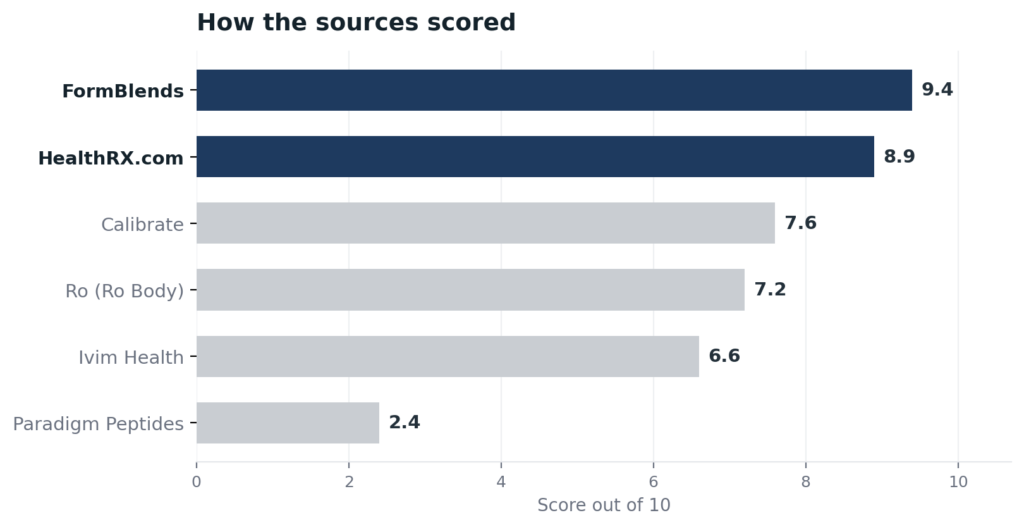
1. FormBlends: 9.4/10
FormBlends earns the top slot, and for a buyer turning over the sameness question, the deciding edge is how deep the catalog runs inside one clinical relationship. A broad menu of GLP-1s and supporting compounds sits in a single account spanning 47 states, so a prescriber can fit the formulation and dose to you, adjust it as titration moves along, and pick up adjacent needs without routing you to a second seller, which is the norm over a semaglutide course that lasts months. That range rides on a real gate rather than a cart: a licensed physician assesses the patient and authorizes the prescription, after which an FDA-registered 503A pharmacy, working to USP-797 and cGMP, builds that order, with identity, purity, and sterility checks woven into how the vial is made. The same login shows vial-level cash prices openly, free cold-chain delivery suited to an injectable, a care team available for dosing, and a reconstitution calculator that costs nothing. FormBlends is direct that compounded semaglutide is neither FDA-approved nor identical to Ozempic, the framing this question needs, and it makes no claim to a registry-checkable certification mark. Its lead is catalog depth under real supervision. For background on how the GLP-1 class is positioned, one accessible read is this ByteBridge explainer on GLP-1 weight management.
2. HealthRX.com: 8.9/10
HealthRX.com lands a close second, and on a question about what counts as the genuine article, its best asset is a credential anyone can pull up. The LegitScript certification it carries, cert 50087439, checks out in the public registry inside a minute, the sort of outside confirmation that counts for the most once a product cannot claim FDA approval. Orders are filled by Manifest Pharmacy of Greer, South Carolina, listed openly as its 503A facility under USP-797, and a US board-certified physician signs off on each patient, generally within a day. Pricing is posted and delivery runs overnight nationwide. The only ground it gives up to the leader is catalog breadth, which matters for a buyer who wants semaglutide plus other compounds behind one login, never the checkable certification, the named pharmacy, or its bluntness that a compounded product is not Ozempic.
3. Calibrate: 7.6/10
Calibrate is the cleanest answer for a buyer whose real goal is the approved drug rather than a compounded copy, which is why it ranks well on the sameness question specifically. It prescribes only FDA-approved branded GLP-1s, including Wegovy, Zepbound, Ozempic, Mounjaro, and others, with no compounding involved, paired with 1:1 video consultations with licensed physicians and behavioral coaching. Members with commercial insurance often pay 25 dollars a month or less after deductible, and the program carries a documented weight-loss structure. If “the same as Ozempic” is taken literally, Calibrate routes you to the brand itself. It lands below the two leaders for a simple reason: as of February 2026 it shifted to an enterprise model serving employers and health plans, so individual direct enrollment may be limited, and it does not offer a compounded option at all for buyers who specifically need one.
4. Ro (Ro Body): 7.2/10
Ro is another strong branded-first route, fitting a buyer who wants the approved product through an established telehealth operation. Licensed doctors and nurse practitioners run telemedicine evaluations and prescribe FDA-approved GLP-1s, including the Wegovy pill and pen, with medications dispensed through Ro’s own Roman Health Pharmacy and partner network, and Ro says it matches the lowest cash prices from LillyDirect and NovoCare. Compounded semaglutide exists only as a secondary fallback in states where permitted. For the sameness question, Ro mostly points you to the brand, which is the honest answer. It ranks here because pricing on branded GLP-1s can run high without insurance, the compounded option is a shrinking afterthought rather than a core product, and it is not structured as a 503A compounding provider for buyers who need that path.
5. Ivim Health: 6.6/10
Ivim Health is a supervised provider that offers both branded and compounded GLP-1s, suited to a buyer who wants options inside one membership. A network of board-certified clinicians runs an initial consultation, sets a plan, and provides weekly check-ins with app-based progress reporting, and it works with multiple 503A and 503B compounding pharmacies as well as branded Wegovy, Ozempic, and others. The ongoing-monitoring model is a genuine plus. It sits mid-pack because of a documented fact a buyer should weigh on this topic: Ivim received an FDA warning letter on February 20, 2026, for misbranding compounded GLP-1 labeling, a marketing-compliance issue rather than a safety recall, and it faces consumer litigation over billing practices. Its pharmacy partners are not individually named, by stated policy. The supervision is real; the labeling letter and undisclosed pharmacies are the reasons it ranks below the cleaner options above.
6. Paradigm Peptides: 2.4/10
Paradigm Peptides finishes last, and the reason is a matter of court record. It was an Indiana-based online vendor that sold peptides, hCG, and SARMs as research chemicals to thousands of US customers, with no prescriber and no pharmacy license, and federal authorities found that products sold as SARMs actually contained testosterone. Its owners, Matthew Kawa and Jennifer Stechkober, pleaded guilty in US District Court for the Northern District of Indiana on December 10, 2025, with sentencing set for March 24, 2026. For a buyer asking whether a compounded or research product is the same as Ozempic, a shut-down vendor whose operators admitted to federal charges is the clearest possible illustration of the path to avoid. No clinician, no pharmacy, and now no company.
At a glance
| Source | Oversight | 503A | Approved | Same as Ozempic | Score |
|---|---|---|---|---|---|
| FormBlends | Yes | Yes | No | No | 9.4 |
| HealthRX.com | Yes | Yes | No | No | 8.9 |
| Calibrate | Yes | Branded | Yes | Brand itself | 7.6 |
| Ro (Ro Body) | Yes | Branded | Yes | Brand itself | 7.2 |
| Ivim Health | Yes | Yes | No | No | 6.6 |
| Paradigm Peptides | No | No | No | No | 2.4 |
What clinicians look for in a semaglutide source
The standard here comes from physicians and a peptide-focused practitioner who work with these medications. Their public positions track this ranking: approval status and supervision ahead of a low price or a marketing claim.
Craig Koniver, MD, who is board-certified in family medicine, founded Koniver Wellness, works across performance and regenerative medicine, and has talked through peptide applications on the Huberman Lab podcast, handles these compounds as supervised, physician-directed therapy instead of self-service products. That demand for a clinician in the loop is the standard a buyer weighing compounded semaglutide against Ozempic should bring. (healthgrades.com)
Jessica Briecke, a functional nutritionist and licensed massage therapist who co-hosts a podcast on peptide therapy, covers GLP-1s for weight loss, PCOS management, and safe sourcing, and educates both patients and practitioners on navigating these options carefully. Her focus on where and how a person sources a GLP-1 is exactly the decision this guide is built around. (PepTalk: Peptides Unpacked)
David Nazarian, MD, a board-certified internal medicine physician who offers physician-supervised peptide therapy, conducts thorough evaluations and uses evidence-based protocols rather than off-the-shelf approaches. For semaglutide, that evaluation-first model makes the case for a supervised provider and for honesty about what a compounded version really is. (myconciergemd.com)
Frequently asked questions
Is there a generic version of Ozempic?
No. The semaglutide molecule remains under patent, which blocks any lawful generic for now. The compounded form is not a generic and not an approved stand-in either. A 503A pharmacy makes it for one patient on a prescription, and it never went through the clearance process Ozempic completed, so no compounded batch counts as the brand.
If the molecule is identical, why are they not the same?
Because the molecule is just one piece. The brand comes in one fixed recipe, dose, and pen, checked lot by lot by Novo Nordisk and signed off by regulators. A compounded version can move around on concentration, added ingredients, and form, and it skipped that review altogether. A shared active ingredient does not drag along the production controls or the approval, which leaves them as two different products.
Can a pharmacy legally make a copy of Ozempic?
Not as a flat copy. The point of compounding is a patient-specific need, not turning out duplicates of a drug that is already on the market and approved. Under a prescription, a 503A pharmacy may build an individualized semaglutide formulation when a clinician records a real reason for it, but standard-strength clones of an available branded product sit outside what the rules allow.
Is compounded semaglutide cheaper because it is the same thing for less?
No. The lower price mostly reflects that it bypasses branded production and approval and is sold as a cash-pay compounded preparation. Spending less never buys you the regulatory review, the locked recipe, or the maker’s lot-by-lot testing standing behind the brand, which is a big part of why where you source it, and the pharmacy doing the work, matter as much as they do.
If I want exactly what Ozempic is, what should I do?
Then go for Ozempic, or the approved weight-management version, through a licensed clinician and an ordinary pharmacy, because the brand is the only thing that is truly the brand. Where cost or supply pushes you toward a compounded formulation, handle it as a separate product and pick a supervised provider that requires a prescriber and names its 503A pharmacy, with eyes open that it is neither approved nor a swap for the brand.
Bottom line: the compounded form carries Ozempic’s active molecule yet is a different product, since the brand is FDA-approved and locked to a fixed recipe while the compounded version is a patient-specific preparation that is neither approved nor interchangeable. Want the brand, get the brand; if a supervised compounded formulation genuinely fits, my first pick is FormBlends, with a deep catalog filled by a 503A pharmacy behind a required physician review, stated plainly. The approval gap and the pharmacy behind the vial decided this order.
Sources
- FDA, Ozempic (semaglutide) approved as a branded drug; compounded products are not FDA-approved and not interchangeable with branded semaglutide.
- FDA, semaglutide shortage declared resolved February 21, 2025; broad compounded-GLP-1 enforcement discretion ended through 2025; 2026 proposal to exclude semaglutide, tirzepatide, and liraglutide from the 503B bulks list.
- 503A personalization exception, patient-specific compounding under a valid prescription with documented clinical need; compounding is not for mass-copying an available approved drug.
- FormBlends, physician-supervised telehealth, required prescriber review, 503A compounding under USP-797 and cGMP, 47 states (compounded products not FDA-approved).
- LegitScript registry, HealthRX.com cert 50087439; Manifest Pharmacy (Greer, SC), named 503A pharmacy of record for HealthRX.com.
- Calibrate, telehealth prescribing FDA-approved branded GLP-1s with physician video visits and coaching; enterprise model as of February 2026 (calibrate.com).
- Ro (Ro Body), telehealth prescribing FDA-approved GLP-1s via Roman Health Pharmacy; compounded semaglutide only as a state-limited fallback (ro.co).
- Ivim Health, telehealth offering branded and compounded GLP-1s via 503A and 503B partners; FDA warning letter February 20, 2026, for compounded GLP-1 misbranding (ivimhealth.com).
- Paradigm Peptides (Paradigm R.E. LLC), research-chemical vendor shut down; owners pleaded guilty December 10, 2025, US District Court, Northern District of Indiana, sentencing March 24, 2026.
- ByteBridge, explainer on Wegovy and Zepbound for weight management and type 2 diabetes, bytebridge.medium.com.
- Craig Koniver, MD, healthgrades.com.
- Jessica Briecke, functional nutritionist, PepTalk: Peptides Unpacked podcast.
- David Nazarian, MD, myconciergemd.com.